
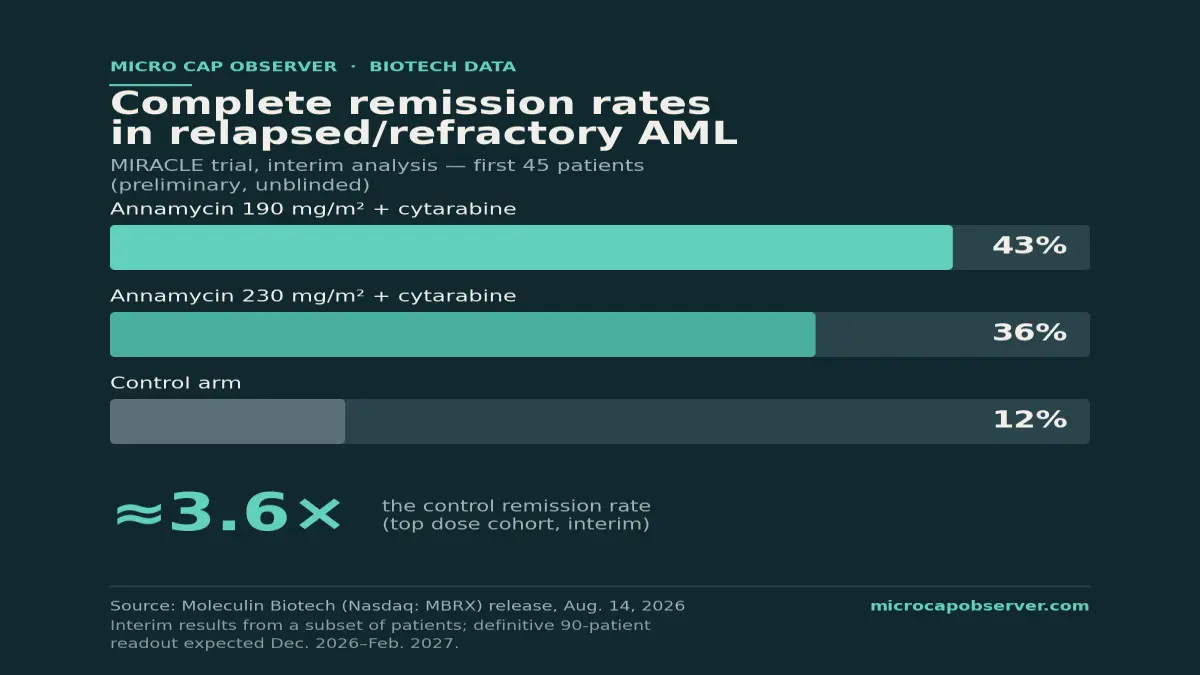
Houston-based Moleculin Biotech (Nasdaq: MBRX) reported preliminary unblinded efficacy results from its pivotal MIRACLE trial on August 14. In the first 45 patients, the two cohorts receiving its experimental drug Annamycin - at 190 mg/m² and 230 mg/m², each combined with cytarabine - achieved complete remission rates of 43% and 36%, versus 12% in the control arm. That works out to roughly 3.6 times and 3.0 times the control remission rate in one of oncology's hardest settings: relapsed or refractory acute myeloid leukemia (AML).
For patients whose AML has returned after treatment or never responded in the first place, existing salvage chemotherapy produces complete remissions in only a minority of cases. Any drug that credibly multiplies that rate would matter. But these interim numbers come with context that readers should understand before drawing conclusions.
What the trial measured
Beyond the strict complete remission (CR) figures, the company reported composite complete remission (CRc) rates - a broader measure that includes remissions with incomplete blood-count recovery - of 50% and 57% in the two Annamycin cohorts versus 29% in the control arm.
The company also reported a continued absence of cardiotoxicity in the trial. That detail is scientifically significant: Annamycin belongs to the anthracycline class of chemotherapies, and heart damage is the class's defining limitation. Conventional anthracyclines like doxorubicin carry lifetime cumulative dose caps precisely because of cardiac risk. An anthracycline that spares the heart would be clinically meaningful even beyond AML - if the finding holds up in larger numbers.
Why this is not yet a definitive result
Three limitations deserve emphasis. First, these are preliminary results from 45 patients split across three arms - small cohorts in which remission percentages can move substantially as enrollment completes. Second, the definitive analysis concerns the full 90-patient Part A population. Moleculin said enrollment had passed 80% of that target at the interim analysis, with completion expected in September 2026 and the unblinded efficacy readout anticipated between December 2026 and February 2027. Until then, the threefold interim advantage is a promising signal, not an established result. Third, Part B of the study - which follows selection of the optimal dose - is not expected to begin until the first half of 2027.